Comprehensive Guide to chose the Right Career in Pakistan
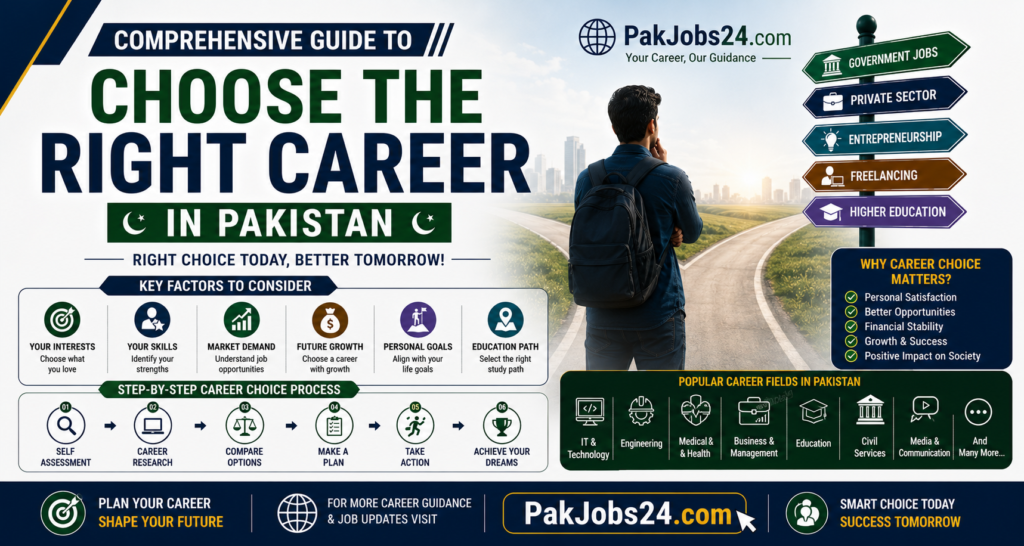
Every year, over 1.5 million students complete their Matric and Intermediate exams in Pakistan, and almost all of them face the same overwhelming question: “What do I do next?” If you’re stuck between what your parents want, what your friends are doing, and what actually excites you, you’re not failing — you’re just missing a system.
The right career in Pakistan is one that matches your natural strengths, fits realistic market demand, and gives you a stable financial future — not necessarily the most popular or prestigious option in your city. Choosing a career is not a single decision; it’s a process of self-assessment, market research, and realistic planning that most students in Pakistan are never taught in school.
This guide breaks that process down into clear, practical steps — built specifically around the Pakistani education system, job market, and cultural realities — so you can make this decision with confidence instead of guesswork.
What Does “Choosing the Right Career” Actually Mean?
Choosing a career doesn’t mean picking one job title forever. It means selecting a field or direction — such as engineering, medicine, civil services, IT, business, or skilled trades — that aligns with three things at once:
- Your aptitude and interest (what you’re good at and enjoy)
- Market demand in Pakistan (and globally, for remote/freelance fields)
- Practical factors like family expectations, finances, and location
A career choice made on only one of these three factors — for example, picking medicine only because it has social status, or IT only because “everyone is doing it” — is a common reason so many Pakistani graduates end up unemployed or unhappy in fields they were pushed into.
Step 1: Assess Yourself Before You Assess the Market
Before comparing FSc pre-medical versus ICS, or CSS versus a private job, sit down and honestly answer these questions:
- What subjects do I naturally understand faster than my classmates?
- Do I enjoy working with people, data, machines, or ideas?
- Am I more comfortable with routine and structure, or with creative, unpredictable work?
- Can I handle years of competitive exam preparation (like CSS or MDCAT), or do I want quicker entry into the job market?
Pro Tip Box: Use Free Aptitude Tools
Pakistani students often skip formal aptitude testing because it feels expensive or unnecessary. In reality, free tools like NTS aptitude sample tests, career counseling sessions at NAVTTC centers, and university-run psychometric tests (offered by institutions like Punjab University and NUST) can reveal strengths you may not notice yourself. Use at least one before finalizing your field.
Step 2: Understand the Career Paths Available After Each Education Level
Pakistan’s education system creates natural decision points. Here is what typically opens up at each stage:
| Education Stage | Common Career Directions |
| After Matric | Diploma of Associate Engineering (DAE), FSc Pre-Medical, FSc Pre-Engineering, ICS, I.Com, Vocational/Technical training |
| After Intermediate (FSc/FA/ICS) | MBBS/BDS, Engineering (BSc), BS Computer Science/IT, BBA, Bachelor’s in Social Sciences, Armed Forces entry (Cadet College routes) |
| After Bachelor’s | Master’s specialization, CSS/PMS competitive exams, Professional certifications (ACCA, CFA, PMP), Direct entry into government or private sector jobs |
If you’ve just finished FSc or ICS, the safest approach is to shortlist 2–3 fields (for example, Computer Science, Engineering, and Business) and compare their admission merit requirements, average tuition cost, and 5-year job outlook before applying — rather than applying to whichever university a friend chose.
Step 3: Compare Government Jobs vs Private Sector vs Self-Employment
This is where most confusion happens in Pakistan, because each path has very different risk and reward.
| Factor | Government Jobs | Private Sector | Self-Employment / Freelancing |
| Job Security | Very high (pension, protection) | Moderate to low | Depends entirely on you |
| Entry Process | Competitive exams (FPSC, PPSC, NTS) | Merit + interview based | No formal exam; skill-based |
| Typical Starting Salary (PKR) | 35,000–80,000 (varies by grade/department) | 30,000–100,000+ (varies by industry) | Highly variable, often 0 initially |
| Growth Speed | Slow but predictable (BPS scale increments) | Faster if performance-based | Fastest, but riskiest |
| Best Suited For | Those who value stability and structure | Those who want faster growth and skill exposure | Self-starters comfortable with risk |
Government jobs in Pakistan — recruited through bodies like the Federal Public Service Commission (FPSC), Punjab Public Service Commission (PPSC), and provincial commissions — remain highly attractive because of pension benefits, job security, and social respect, particularly for roles in the civil service, education, health, and armed forces (Army, Navy, Air Force, and Marines).
Private sector jobs in banking, telecom, and multinational corporations often pay more initially and reward performance faster, but with less long-term security.
Self-employment and freelancing — especially in IT, digital marketing, and graphic design — has grown rapidly in Pakistan due to platforms like Fiverr and Upwork, with Pakistan ranking among the top freelancing countries globally in recent years.
Step 4: Research Real Market Demand — Not Just Popularity
A field being popular in your city doesn’t mean it has real, sustained demand. To evaluate this properly.
- Look at which departments are actively recruiting (education, health, IT, engineering, and defense sectors have shown consistent hiring in Pakistan)
- Ask working professionals in that field about actual day-to-day work — not just salary
- Check skill-based demand, since fields like data analysis, cybersecurity, and digital marketing are growing even without large traditional job postings
Step 5: Factor In Family, Finances, and Location Realistically
Pakistani students often face pressure to choose fields for family prestige rather than personal fit. A balanced approach means.
- Being honest with parents about your strengths using evidence (grades, test results, teacher feedback) rather than emotional arguments alone.
- Calculating the real cost of education (tuition, hostel, books) against your family’s capacity, especially for private medical or engineering degrees.
- Considering location flexibility — some careers (IT, freelancing, remote work) don’t require relocating to Karachi, Lahore, or Islamabad, which matters for students from smaller cities.
Expert Tip Box: The “Two-Path Rule”
Whenever possible, keep one backup path alongside your primary goal. For example, a student preparing for MDCAT can simultaneously keep FSc-based BS options (like Biotechnology or Pharm-D) open. This reduces the pressure of an all-or-nothing decision and is a strategy career counselors across Pakistan recommend.
Common Mistakes Pakistani Students Make When Choosing a Career
- Choosing based on peer pressure instead of personal aptitude
- Ignoring competitive exam realities — for example, underestimating how difficult CSS or MDCAT merit actually is
- Overlooking technical and vocational fields (DAE, NAVTTC trades) that have strong, steady demand and shorter completion time
- Not researching salary progression, only the starting salary
- Making a permanent decision under temporary family or social pressure
Frequently Asked Questions (FAQs)
What is the best way to choose a career in Pakistan after Matric?
Assess your strongest subjects, take an aptitude test if possible, and compare at least three realistic paths (for example, FSc Pre-Engineering, ICS, or DAE) based on your interest and your family’s financial capacity before committing.
Is a government job better than a private job in Pakistan?
Neither is universally “better.” Government jobs offer stronger long-term security and pension benefits, while private sector jobs often offer faster salary growth and skill exposure. The right choice depends on whether you prioritize stability or growth speed.
How do I know if I’m choosing a career for myself or because of family pressure?
If you struggle to explain why you want a field beyond “my parents want it” or “it’s respected,” that’s a sign to pause and honestly compare it against your actual academic strengths and interests.
Which careers are currently in high demand in Pakistan?
IT and software development, healthcare (especially nursing and allied health), engineering (especially electrical and civil), education, digital marketing, and armed forces recruitment (Army, Navy, and Air Force) consistently show strong and steady demand.
Can I change my career path later if I choose the wrong field?
Yes. Many professionals in Pakistan switch fields through additional certifications, a second bachelor’s, or by transitioning into adjacent roles — for example, an engineering graduate moving into project management or an ICS graduate moving into digital marketing.
Should I choose a career based on salary or personal interest?
Ideally, both — but if forced to choose, sustained success is more likely in a field that matches your natural aptitude, since skill and interest usually drive long-term salary growth more than the field’s starting pay alone.
Is freelancing a reliable career option in Pakistan?
Freelancing can be a genuinely reliable option if you build in-demand skills (like web development, graphic design, or digital marketing) and treat it as seriously as a formal job, though it requires more self-discipline than a structured job.
Conclusion: Take Control of Your Career Decision
Choosing the right career in Pakistan isn’t about finding a perfect, risk-free answer — it’s about making an informed decision based on your genuine strengths, honest market research, and realistic personal circumstances, instead of pressure or guesswork. Use the steps above to shortlist your options, test them against real data, and commit to a direction with a backup plan in place.
Ready to take the next step? Visit PakJobs24.com for daily updated government job vacancies, detailed salary guides, and test preparation resources to help you turn your career decision into a real opportunity.
Also read about: How to Start a Career in Civil Service in Pakistan