Start your Career in Civil Services Complete Guide
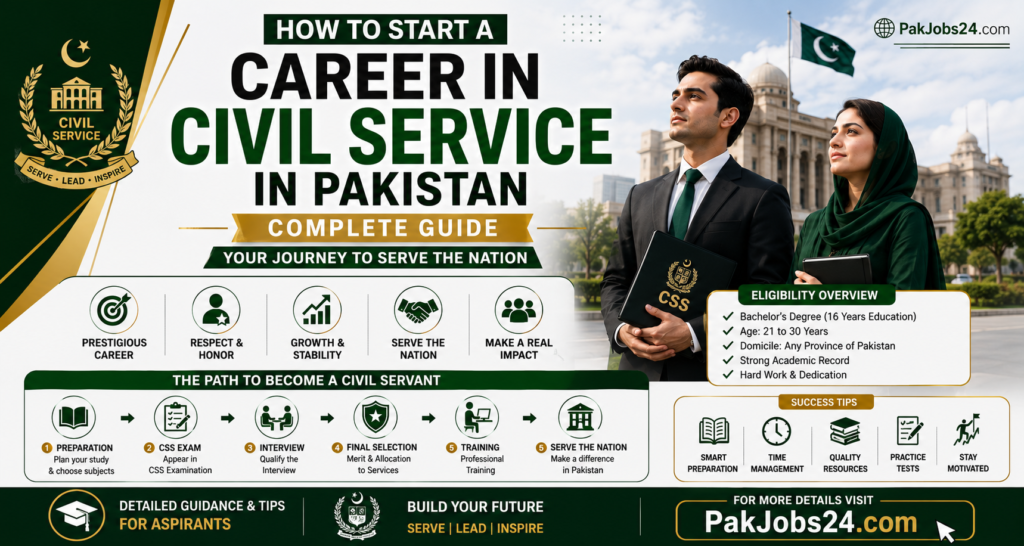
Want to start a career in civil service in Pakistan? Here is the direct answer: you must pass the Central Superior Services (CSS) exam conducted by the Federal Public Service Commission (FPSC), meet the eligibility criteria, and complete mandatory training at the Civil Services Academy in Lahore.
Every year, thousands of talented young Pakistanis dream of wearing the badge of a District Commissioner, a Foreign Service officer, or a Police Service officer. Yet fewer than 3% of CSS applicants actually succeed. Why? Because most candidates prepare without a clear roadmap.
Imagine this: a 24-year-old graduate from any city of Pakistan with no sifarish (recommendation), no connections, and no expensive coaching — just a structured plan and the right knowledge — clearing the CSS exam and joining the Pakistan Administrative Service.
That story happens every year. This guide gives you exactly that road map — from understanding what civil service is to submitting your application, cracking the exam, and building a rewarding career that touches millions of lives across Pakistan.
Brief History of Civil Services in Pakistan
The civil services system of Pakistan has its roots in the British colonial era. Before independence, the British governed the Indian subcontinent through the Indian Civil Service (ICS). The ICS was considered one of the most prestigious administrative services of its time. Initially, most officers were British, but later many Indians also joined the service through competitive examinations.
After the creation of Pakistan in 1947, the country inherited much of the administrative structure developed during British rule. Pakistan introduced the concept of Central Superior Services (CSS) to recruit talented individuals for key government positions. Various services were established to manage administration, policing, foreign affairs, taxation, customs, accounts, and other government functions.
A major turning point came in 1973 when civil service reforms were introduced. These reforms created a unified training system for newly selected officers. All successful candidates were required to undergo common training at the Civil Services Academy in Lahore before receiving specialized training in their respective occupational groups. This system continues today.
Over the years, Pakistan’s civil services have played a vital role in governance, policy implementation, public administration, and national development. Officers selected through the CSS examination serve in different federal and provincial departments and contribute to the functioning of the state.
Among the various occupational groups, the Pakistan Administrative Service (PAS), formerly known as the District Management Group (DMG), is one of the most prominent. PAS officers often serve as Deputy Commissioners, Commissioners, Secretaries, and other senior administrators responsible for managing public affairs and implementing government policies.
Today, the Civil Service of Pakistan remains one of the most respected career paths for individuals who wish to serve the nation, contribute to policymaking, and take leadership roles in government administration.
What is Civil Service in Pakistan?
Civil service refers to the permanent, professional branches of government administration that are neither political nor judicial. In Pakistan, civil servants are selected through competitive examinations and serve the state regardless of which political party is in power.
Definition Box: Civil Service in Pakistan is the collective body of government officials employed under federal and provincial governments, selected through merit-based examinations conducted by FPSC and Provincial Public Service Commissions (PPSCs).
Pakistan inherited its civil service structure from the British colonial system. Today, the civil service is divided into Occupational Groups (OGs) under the federal government and provincial cadres under each province.
Civil Service Groups and Occupational Categories in Pakistan
Federal Occupational Groups Under CSS
| Occupational Group | Abbreviation | Key Role |
| Pakistan Administrative Service | PAS | District administration, governance |
| Police Service of Pakistan | PSP | Law enforcement, policing |
| Foreign Service of Pakistan | FSP | Diplomacy, embassies abroad |
| Inland Revenue Service | IRS | Tax collection (FBR) |
| Pakistan Audit & Accounts Service | PAAS | Financial auditing |
| Pakistan Customs Service | PCS | Trade, border customs |
| Office Management Group | OMG | Secretariat management |
| Information Group | IG | Media, information ministry |
| Commerce & Trade Group | CTG | Trade policy |
| Postal Group | PG | Pakistan Post |
| Military Lands & Cantonments Group | MLCG | Cantonment management |
| Railways (Commercial & Transportation) Group | RCTG | Pakistan Railways |
Pro Tip: PAS (Pakistan Administrative Service) and PSP (Police Service of Pakistan) are the two most competitive and prestigious groups. Top-scoring candidates are allocated these groups first.
Eligibility Criteria for CSS Exam in Pakistan
Before you begin preparation, confirm you meet every requirement:
Age Requirement
- Minimum age: 21 years
- Maximum age: 30 years (general)
- Age relaxation: Up to 35 years for government servants and certain categories under FPSC rules.
Educational Qualification
- Minimum: Second Class or Grade C Bachelor’s degree (14 years of education) from a HEC-recognized university
- Students in their final year of graduation may apply provisionally
Domicile & Nationality
- Must be a Pakistani citizen
- Must hold a valid domicile certificate of any province or Islamabad Capital Territory (ICT)
Physical Standards
- Candidates must meet medical fitness standards as defined by the Civil Services (Medical Examination) Rules
- PSP and certain other groups have additional physical requirements.
Number of Attempts
- Maximum 3 attempts allowed within the eligible age bracket
Step-by-Step Guide: How to Start Your Civil Service Career
Step 1 — Build Your Academic Foundation
Start early. Your academic record matters, but your Bachelor’s degree subject choices matter even more for CSS subject selection.
- Pursue a Bachelor’s or Master’s degree in subjects relevant to CSS optional papers
- Strong subject choices include: Political Science, International Relations, Public Administration, History, Economics, English Literature
- Maintain at least Second Division (45% marks or Grade C) to qualify
Step 2 — Understand the CSS Exam Structure
The CSS written examination consists of two parts:
Compulsory Papers (600 marks total)
| Paper | Marks |
| English Essay | 100 |
| English Précis & Composition | 100 |
| General Science & Ability | 100 |
| Current Affairs | 100 |
| Pakistan Affairs | 100 |
| Islamic Studies / Ethics | 100 |
Optional Papers (600 marks total):
- Choose 6 optional papers from approved subjects (100 marks each)
- Popular choices: International Relations, Political Science, Public Administration, Economics, History of Pakistan & India
Total: 1,200 marks written + psychological assessment + viva voce (interview)
Step 3 — Apply Through FPSC
- Visit the official FPSC website: www.fpsc.gov.pk
- Applications open typically in October–November each year
- Submit online application with required documents:
- CNIC copy
- Educational certificates
- Domicile certificate
- Recent photographs
- Application fee (currently approximately PKR 2,000–2,500)
Step 4 — Prepare a Structured Study Plan
CSS preparation typically requires 12 to 24 months of dedicated study. Here is a proven framework:
1st Phase (Months 1–6): Foundation Building
- Read Dawn newspaper daily for current affairs
- Study Pakistan Affairs from M. Ikram Rabbani’s Introduction to Pakistan Studies
- Practice English essay writing weekly
- Build vocabulary using quality word lists
2nd Phase (Months 7–12): Subject Mastery
- Deep-dive into your 6 optional subjects
- Solve past papers from the last 10 years (available on FPSC website)
- Join a reputable CSS study group or academy in Lahore, Islamabad, or Karachi
3rd Phase (Months 13–18): Revision & Practice
- Write full-length timed essays twice a week
- Mock exams for all compulsory papers
- Current affairs revision: both national and international
Expert Tip: The English Essay paper is one of the biggest differentiators. Candidates who score 70+ in Essay almost always make it to the final merit list. Practice writing structured argumentative essays on governance, economy, and social issues every single week.
Step 5 — Clear Psychological Assessment & Viva Voce
Candidates who pass the written examination proceed to:
- Psychological Assessment — conducted at the Federal Public Service Commission offices; tests personality, leadership traits, decision-making, and mental stability
- Viva Voce (Interview) — a panel interview assessing communication, current awareness, professional judgment, and personality
The interview carries 300 marks and can make or break your final merit position.
Step 6 — Complete Civil Services Academy Training
Successful candidates undergo training at the Civil Services Academy (CSA), Lahore — the premier training institution for Pakistan’s civil servants since 1948. Training typically lasts 6 months and covers:
- Public administration and governance
- Law, economic policy, and management
- Field visits and practical administrative exercises
- Physical training and leadership development
Provincial Civil Service: An Alternative Path
Not everyone needs to clear CSS to enter civil service. Provincial Public Service Commissions (PPSCs) offer excellent careers at the provincial level.
- PPSC (Punjab) — Punjab Public Service Commission, Lahore
- SPSC (Sindh) — Sindh Public Service Commission, Karachi
- KPPSC (KPK) — Khyber Pakhtunkhwa Public Service Commission, Peshawar
- BPSC (Balochistan) — Balochistan Public Service Commission, Quetta
- FPSC (Federal) — Federal Public Service Commission, Islamabad
Provincial PMS (Provincial Management Service) officers can also be inducted into the federal cadre through competitive processes after several years of service.
Pro Tip: If CSS feels too competitive right now, start your journey through PPSC PMS exam in your province. Many successful federal secretaries today began their careers as Provincial Management Service officers.
Key Resources for CSS Preparation
| Resource | Type | Purpose |
| Dawn Newspaper | Daily | Current affairs, editorial reading |
| The News International | Daily | Analysis, Pakistan affairs |
| FPSC Past Papers | Practice | Exam pattern familiarity |
| M. Ikram Rabbani | Book | Pakistan Studies |
| Merriam-Webster Dictionary | Reference | English vocabulary |
| Vision CSS Academy | Coaching | Lahore, Islamabad, Karachi |
Frequently Asked Questions (FAQs)
What is the civil service in Pakistan?
Civil service in Pakistan is the permanent body of government officials employed under federal and provincial governments to administer state functions. They are selected through competitive examinations conducted by FPSC and PPSCs and serve regardless of political changes.
What is the CSS exam and who conducts it?
The Central Superior Services (CSS) exam is Pakistan’s premier competitive examination for federal civil service recruitment. It is conducted annually by the Federal Public Service Commission (FPSC), Islamabad. It selects officers for 12 occupational groups including PAS, PSP, and FSP.
What is the age limit for CSS exam in Pakistan?
The age limit for CSS exam is 21 to 30 years for general candidates. Age relaxation of up to 5 years is available for government employees and certain other categories as per FPSC rules.
What educational qualification is required for CSS exam?
You need a minimum Second Class Bachelor’s degree (14 years of education) from an HEC-recognized university. Final-year students may apply provisionally but must submit their degree before document verification.
How many attempts are allowed in CSS exam?
FPSC allows a maximum of 3 attempts in CSS examination, all within the eligible age bracket. It is important to use attempts wisely with thorough preparation.
What is the starting salary of a CSS officer in Pakistan?
A newly inducted CSS officer joins at BPS-17 with a basic salary of approximately PKR 65,000 to PKR 80,000 per month. Including allowances and perks such as official residence and vehicle, the effective package is significantly higher.
How long does CSS preparation take?
A realistic and thorough CSS preparation takes 12 to 24 months of consistent, structured study. Many successful candidates prepare for 18 months, combining self-study with coaching and daily newspaper reading.
Can a girl appear in CSS exam in Pakistan?
Yes, absolutely. Women Start a Career in Civil Service. Women are eligible for all CSS occupational groups including PAS, PSP, and FSP. The FPSC encourages female participation, and gender is no barrier to any group allocation based on merit.
Conclusion
Start a Career in Civil Service in Pakistan is one of the most rewarding and impact full professional decisions a young Pakistani can make. It demands sacrifice, discipline, and consistent preparation — but the reward is a lifetime of meaningful public service, job security, and respect.
Also read about: How to Join Pakistan Air Force — Complete Guide for Males & Females